


DemolitionSteve Heimsath
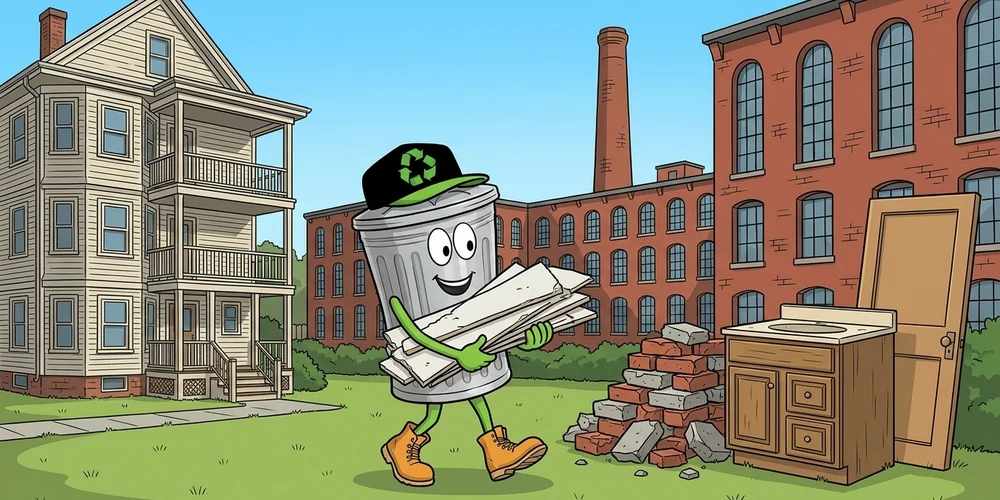
A remodel always leaves a pile: broken tile, drywall, a vanity, a toilet, a door off its hinges. In Lowell most of it has a legal way out, but no single route takes all of it, and the easiest-looking one, the trash cart, can earn you a fine.
Here is how to get rid of construction debris in Lowell without one, what each route takes, and what it costs to have us haul the whole pile.
What Happens If You Dispose of Construction Debris With Lowell Trash?
If it is one of the building materials Massachusetts bans from disposal, you can be fined $200 for every piece. Lowell’s waste ordinance, Chapter 270 of the city code, sets that fine for anyone who puts state-banned waste out for curbside collection, and it counts each piece of waste as a separate offense. That covers the trick Massachusetts Reddit threads often suggest, slipping it into the weekly trash a bag at a time.
The rest of the job stays out of the cart too. WM, which collects Lowell’s trash under contract with the city, lists construction waste among the items that do not go in the cart on its Lowell service page.
Some bigger remodel pieces do have a legal curbside route, covered two sections down.
Can You Dispose of Concrete, Brick and Clean Drywall Anywhere in Massachusetts?
Not as trash, anywhere in the state: no landfill, transfer station or incinerator in Massachusetts may accept them for disposal. MassDEP’s waste ban regulation, 310 CMR 19.017, has barred asphalt pavement, brick, concrete and metal from disposal since July 1, 2006, and clean gypsum wallboard, which is drywall, since July 1, 2011. Wood has been banned from landfills since 2006, though MassDEP still lets it go to waste combustion plants.
Drywall is banned only when it is clean
MassDEP’s solid waste regulations define clean gypsum wallboard as drywall not contaminated with paint, wallpaper, joint compound, adhesives, nails or other substances after manufacture. Fresh scraps from hanging new sheets usually qualify. A painted wall you just tore out, nails and joint compound and all, does not.
The ban stops at disposal
MassDEP’s June 2020 FAQ on these bans says all six materials have recycling and reuse markets, that C&D processors take mixed loads, and that recyclers are cheaper still for material sorted on the job. Those six are the only construction materials it bans, though cardboard, large appliances, tube TVs and whole tires from a job have bans of their own. Tile, plaster and asphalt shingles are not on the list, but they still stay out of a Lowell trash cart.
If you have a truck, call a recycler or C&D processor before you load it, and ask whether they take loads from homeowners, what they take and what they charge.
What Renovation Debris Will Lowell’s Bulky Pickup Remove?
More than most people expect. WM runs Lowell’s bulky pickup for the city, by appointment only, with the fee paid over the phone at 800-972-4545, the number the city lists. The fee list on the city’s Solid Waste and Recycling page names these remodel leftovers:
- A door: $27
- A vanity with sink: $27
- A fiberglass tub and surround: $27
- Carpeting, listed as a 3-foot roll: $27
- A toilet or porcelain sink: $35
Two limits that matter on a remodel
Lowell’s waste ordinance defines a bulky item as one weighing less than 100 pounds, and it limits each household to two such items a week, appliances included. A gutted bathroom can be four items on its own, so plan on at least two weeks of pickups, or a different route for the rest.
Not every building qualifies
The fee list says WM collects from eligible addresses, and the ordinance limits curbside service to households: buildings of up to four units, up to six if the owner lives there, and mixed-use buildings of up to four units. A five- or six-unit rental the owner does not live in falls outside the city’s service, and so does anything bigger.
Loose debris is not on the list at all, so broken tile, plaster and drywall scraps need another route. For towns to the east, we compared the bulky trash rules in seven Merrimack Valley towns.
Where Can You Donate Leftover Construction Materials Around Lowell?
The city’s donation page lists Boston Building Resources for construction material, and it also lists the Habitat for Humanity of Greater Lowell ReStore in North Billerica. Only one of the two is still open.
Boston Building Resources is a reuse center at 100 Terrace Street in Boston. Its donation page says it accepts donations at staff discretion, encourages donors to book an appointment and read its guidelines first, and offers pickup for a fee, so ask whether that reaches Lowell.
The ReStore is gone. Habitat for Humanity of Greater Lowell’s website says its ReStore closed permanently in March 2026, and it points donors to other Habitat ReStores in Massachusetts.
Whichever you try, call before you load the car and describe what you have. Unopened boxes of tile or extra lumber can also be offered free on the Lowell Freecycle group the city lists. If you hire us for the rest, we pull out what can be recycled, metal especially, which keeps the disposal weight and your price down.
How Much Construction Waste Can a Bagster Haul for Lowell Homeowners?
Up to 3,300 pounds, in a bag 8 feet long, 4 feet wide and 2.5 feet tall, according to the city’s page on extra trash, which lists the bag at $35 from local home improvement stores or online. Collection costs extra: you book it online once the bag is full, and the city says the removal price varies, so get that number, and Bagster’s rules on where the bag can sit, before you buy.
Do the math before you fill it. The bag holds 80 cubic feet, so a full one can average only about 41 pounds per cubic foot before it reaches 3,300 pounds. With heavy debris, the weight limit is the one you hit first.
The same city page says Bagster collection does not take electronics, appliances, tires, food or anything toxic or otherwise dangerous. For leftover paint, stain and solvents, the City of Lowell holds two household hazardous waste days in 2026, and you pay a fee to drop them off. The fall one is Saturday, November 7, from 9 a.m. to noon, with a limit of 120 visitors and one car per household.
Already filled one and nobody has come for it? We pick up full Bagsters too, and we price them the way we price any load.
Does Old Floor Tile From a Lowell Remodel Need Special Disposal for Asbestos?
It can, if the tile contains asbestos, and you cannot tell by looking. MassDEP’s June 2026 FAQ on its asbestos regulation lists vinyl floor tile, vinyl sheet flooring and flooring mastic among suspect asbestos-containing materials, along with asphalt roofing, whatever the age of the building. The only way to know for certain is a lab test.
We do not take asbestos. If you suspect it, do not start pulling up the floor: MassDEP’s advice for asbestos material in good condition is to leave it alone. Call a licensed asbestos inspector or contractor, and see MassDEP’s asbestos notification rules before any work starts.
Here is the rule that catches homeowners. MassDEP’s asbestos regulation, 310 CMR 7.15, requires a survey by an asbestos inspector licensed by the state Department of Labor Standards before demolition or renovation in a building that contains suspect material. The only exception is a homeowner doing the work themselves, on non-friable material, in their own single-family, owner-occupied home. A Lowell two-family or triple-decker is not a single-family home, and the exception ends once you hire someone else to do the work.
If the tile does contain asbestos, MassDEP lets intact and unbroken vinyl asbestos tile, removed in accordance with its regulations, go to a MassDEP-permitted solid waste landfill as solid waste. Before disposal is arranged, MassDEP recommends that the landfill be told the tile contains asbestos. Broken or crumbled tile and other asbestos floor tile debris must be handled as asbestos-containing waste, and no asbestos waste may go to a C&D processor.
What Decides the Cost of Demolition Debris Removal in Lowell?
What the load weighs, how long the job takes and how far we carry it. That is how we price our construction debris removal, and you approve the number before anything moves.
What moves the number
We estimate what a load weighs before we start, because weight is the biggest single input: a truck of tile and a truck of pillows cost us very different amounts. Wood and trim also price very differently from plaster, concrete and tile, so tell us roughly what is in the pile when you call and the phone estimate lands closer. A pile stacked where the truck can reach it, such as your driveway, costs less than one we carry out of the house, and anything we can recycle or resell comes off the price.
Wherever the pile sits, you do not lift anything. Two or three of us come and do the carrying.
A truckload for scale
Our pricing page lists $125 to $155 as the average for a full-size pickup truck load, which is 2.5 cubic yards, before coupons and discounts. Concrete, brick and plaster are heavy, and we price on weight, so treat that range as a reference point, not a quote for a load of debris. The same page puts a dumpster at $80 to $120 for those 2.5 cubic yards. That is cheaper than us, but you do the loading, and it sits on your driveway until collection day.
If something has to come down first, our demolition services cover the teardown, the hauling and the cleanup in one price. If the debris is an old shed, see what a shed teardown costs in our Derry guide.
Your Next Step
Sort the pile first. Bulky pieces under 100 pounds can go to WM’s bulky pickup for a fee if your building qualifies, banned materials go to a recycler or processor that takes homeowner loads, leftover new material can be offered to a reuse center or given away, and old tile waits for a test.
If you would rather have the whole pile gone in one visit, call or text 603-490-2177 and tell us roughly what is in it. Here is how our construction debris pickup works, and we also cover junk removal next door in Tewksbury.