


Junk RemovalSteve Heimsath
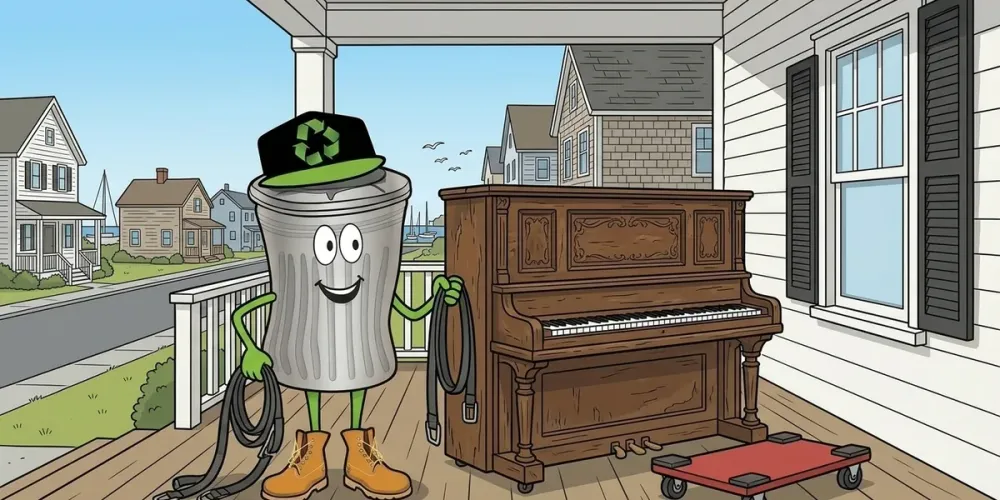
So you have questions about getting rid of a piano in Portsmouth, New Hampshire. Good, that is what this post is for. We are going to cover why pianos are so hard to give away, whether you can donate one locally, what piano removal costs, why moving it yourself is a bad idea, and what happens to the instrument afterwards.
The hardest thing to give away for free in New England is an upright piano. People are always surprised by that, because it cost thousands of dollars, it is beautiful furniture, and surely somebody must want it.
In practice the free listings sit for months. The reason is simple economics: taking it costs the recipient more than the piano is worth to them.
Why is it so hard to get rid of a piano?
Three separate things stack up here. None of them is about your particular piano being bad, which is why a good instrument can be just as stuck as a poor one.
An upright piano is extremely heavy
A small spinet is the light end of the scale and a full upright with a cast-iron plate is the heavy end. That plate is the reason for the weight. It is solid iron because it has to hold the tension of every string in the instrument, and it accounts for most of what you are trying to move.
Charities will not take them
Pianos and organs appear on the do-not-accept list for the major donation pickups, alongside mattresses and stained upholstery. It is not snobbery on their part. They cannot move them safely and they cannot sell them, so accepting one just creates a disposal cost for a charity. We covered what donation pickups will and will not take in more detail.
Used upright pianos have no resale market
Digital pianos are lighter, cheaper, hold their tuning indefinitely and do not need a specialist to move them. That killed the second-hand market for everything except good grands and quality uprights in genuinely playable condition. An ordinary used upright now costs more to move than it is worth.
Can you donate a piano in Portsmouth instead of scrapping it?
Sometimes, and it is worth the two phone calls before you give up on the idea. The answer depends almost entirely on whether it still plays.
If it holds a tune, the action works and the case is sound, then a school, a church, a community theatre or a music program may genuinely want it. That is a real donation rather than a disposal problem in disguise, and it is worth pursuing properly.
Have a technician look at it before you offer it anywhere. A piano tuner will tell you in about ten minutes whether you have an instrument or a piece of furniture. A cracked soundboard, split bridges or loose tuning pins are the answers that end the conversation. The Piano Technicians Guild can help you find somebody local. It is a small fee that saves you weeks of hopeful phone calls.
The Seacoast also has more takers than most areas. Portsmouth supports an unusual amount of music for a city its size, between the venues, the churches and the schools. If yours is genuinely playable, ask locally before assuming nobody wants it.
What does piano removal cost in Portsmouth?
It is priced on access and stairs. This is one of the very few items where the object itself really is the problem rather than the route out of the house.
Single items start at $35, but a piano is rarely the floor price
An upright on a ground floor with a straight path to the door is a manageable job and sits near the cheaper end. That is the easy version and it is not the common one. Our pricing page explains how the number gets built.
Stairs change everything about the job
Portsmouth has a lot of older housing with narrow staircases and turns at the landing. An upright does not go round a turn without a plan. That is a job for straps, a piano board and enough people, or it becomes a job where the piano comes apart in the room it stands in.
Cutting it down on site is normal, and it is not vandalism. For a piano with no musical value left, dismantling it where it stands is very often the only way it leaves the building. The iron plate goes to scrap and the wooden case goes as wood. People sometimes feel bad about this, and it is worth saying that the alternative is usually the piano staying where it is.
We price it before anything moves, and we beat written quotes by up to 10%
You approve the number first, before anybody touches the instrument. $40 comes off any job. If the piano is part of a larger clearance, an estate cleanout usually works out cheaper than handling it separately.
Should you move a piano yourself?
This is the one job on our whole site where we would genuinely rather talk you out of it. The reasons are not commercial.
Why a piano is dangerous to move
They are top-heavy, the weight is distributed very unevenly, and the casters on an old upright are decorative rather than functional. A piano that starts moving on a staircase does not stop, and there is nothing useful a person can do about it once it has.
Old casters seize
They are almost always seized, cracked or simply the wrong size for a modern floor. People assume the piano will roll out of the room the way it rolled in. It will not, and finding that out halfway across a hallway is how floors get gouged.
What a dropped piano costs in floors and doorframes
The repair bill for a piano dropped on a hardwood landing comfortably exceeds the cost of having somebody take it away properly. That is before anybody gets hurt. It is a bad trade in every direction.
What happens to a piano after it is hauled away?
It divides into two genuinely useful materials and a fairly small amount of actual waste. Very little of a piano needs to be buried.
The iron plate and strings are scrap metal. That is the heaviest part of the instrument and it is entirely recyclable. In 2025 we recycled over a million pounds of scrap metal, and pianos contribute more per item than almost anything else. Where the junk goes covers the route.
The case is solid timber and veneered panels. The wood goes as wood. Either way it is not a difficult material to deal with once the iron is out of it.
The ivory question comes up almost every time and the answer is usually no. Keys on most twentieth-century uprights are plastic rather than ivory. If yours is genuinely old enough to have real ivory, there are restrictions on selling it, and that is worth checking before it goes anywhere at all.
What is the fastest way to get a piano removed in Portsmouth?
If it plays, get a technician to confirm that and then offer it to a school, a church or a music program locally. That is comfortably the best outcome for a decent instrument and it costs you almost nothing.
If it does not play, or nobody has taken it in three months, or it is upstairs, then it is a crew job. Call or text 603-490-2177, we cover Portsmouth and the Seacoast, and here is exactly how our piano removal works.