


Furniture & AppliancesSteve Heimsath
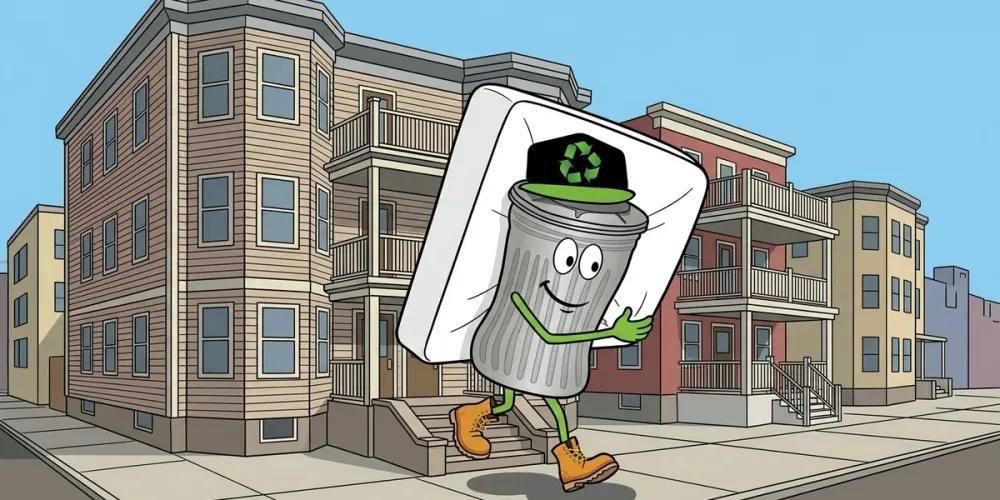
So you have questions about mattress disposal in Boston. Good, that is what this post is for. We are going to cover why the city will not take a mattress with your regular trash, who the city’s appointment leaves out, what Boston refuses to collect under any circumstances, why the staircase is the real job, and what mattress removal costs when you have us do it.
Boston will not collect a mattress with your curbside trash. It runs them through an appointment instead, and three conditions are attached. You need the appointment, you need to live in a building with six units or fewer, and you get ten items a year. Miss any one of those and the truck goes straight past your mattress and takes everything else.
We are Trash Can Willy’s. We are veteran-owned, A+ rated by the Better Business Bureau and 17+ years in business, and we carry the mattress out of the room it is in. Call or text 603-490-2177 for a guesstimate. The crew confirms the exact price on site before any work starts.
The city rules below come from the City of Boston’s own mattress recycling and special collection pages and from MassDEP, checked on 23 August 2026. They are here as reasons to call us, not as instructions for doing it yourself. Boston updates those pages, so check the date before you rely on anything.
Why you cannot put a mattress out with the trash
The state stopped it, not the city. Boston is following a rule that applies everywhere in Massachusetts, from Lawrence to the Cape.
MassDEP added mattresses and textiles to its waste disposal ban list, effective 1 November 2022. The full ban list covers more than most people expect, including white goods, cathode ray tubes, metals and clean gypsum wallboard. Because it is a state rule rather than a city one, it works the same way in Boston, Lawrence and Lowell. We wrote up why the ban exists and what it changed separately.
One exception catches people out constantly. A futon or a mattress topper is not a mattress, and Boston will not accept either on a mattress appointment. Those go out with your normal curbside trash instead, which is the opposite of what most people assume.
Who the city’s appointment leaves out
This is the rule that catches most of Boston, and the city’s own answer is to hire somebody.
Boston’s curbside mattress program covers buildings with six units or fewer, full stop. A triple-decker is in. A seven-unit block is out. If you are in a larger building the city tells you to speak to your property manager and points you at a list of private haulers. That is not a loophole to argue with, it is how the program is funded.
Ten items a year is the cap even if you do qualify. Curbside mattress pickup is limited to ten items per calendar year per address, so an eleventh puts you in exactly the same position as a large building. That matters most to landlords turning over furnished units, and it is a common reason we get called for an eviction cleanout.
The city also will not come onto private property for any of it. A mattress in a driveway, a side yard, an entryway or a back hall is not collected, whatever the appointment says. It has to be at the curb, which means somebody has already carried it down the stairs, and that somebody is you.
What Boston will not collect at all
There is a second list, and this one has no appointment behind it. The city names large exercise equipment, construction material, water heaters, plumbing fixtures and dishwashers as items it does not collect, and tells residents to donate them or hire a private hauler.
Freon and screen items are a separate appointment again, capped at ten a year and no more than five per appointment, with fridge and freezer doors removed and no commercial grade items accepted. There is no year-round municipal drop-off a Boston resident can simply drive to. The city runs a handful of Zero Waste Day events instead, residents only, with proof of address, and no construction debris.
Clear a bedroom and you hit both lists at once: the mattress on one appointment, the television on another, and the old treadmill on neither. We take the lot in one visit.
What it costs to leave one at the curb and hope
It sits there, and then it becomes your problem again. This is the outcome we get called about most often.
Boston is explicit that it will not collect any mattress without an appointment. A mattress at the curb with no booking is not in the system, so nothing is coming for it. It will still be there on Tuesday, and by then it has usually rained.
There is advice going around locally that is worth ignoring, and it comes up every single time this is discussed: carry it to a building with fewer than seven units, or leave it in a park and report it to 311. That is illegal dumping. The city posts flat fines for this, and illegal dumping runs from $100 upwards. The mattress is traceable back to you more often than people assume, and it is the direct reason mattresses sit on Boston sidewalks for weeks.
Lease turnover is the worst possible time to discover any of this. Boston turns over an enormous number of leases on the same day, and a mattress left behind becomes the landlord’s problem and then your deposit’s problem. The same squeeze hits furniture on a Cambridge move-out, where the rules are different again.
Donating a mattress rarely works
Salvation Army and Goodwill decline mattresses far more often than people expect, and hygiene rules are the reason. The Salvation Army’s own donation guidance is the place to check before you plan around it. Do not build your week around a pickup that has not been confirmed for the specific item you have.
If it is genuinely clean and sound, listing it free and letting somebody with a truck collect it does work, and it costs nothing. That is the honest answer for one good mattress. It is not an answer for a stained one, a bed-bug one, or the four pieces of furniture standing next to it.
What we take in Boston
The mattress, the box spring, the bed frame and everything else in the room. Furniture, appliances, electronics, household clutter, construction debris, hot tubs and pianos go on the same truck, and none of it has to reach the curb first.
You point and we do the lifting. Two or three of us handle the stairs and the carrying, which in this city is most of the actual job. A queen mattress in a third-floor walk-up with a turn in the stairs is a genuine two-person job, and that is the work, not the driving. We watch your corners, your carpets and your floors on the way out, and we sweep the space before we leave.
Up to 85% of what we haul is recycled or donated. Mattresses go to a recycler that takes the steel, foam and wood back out of them rather than to a hole in the ground.
How our pricing works
We price on weight, labor, difficulty and access rather than by the piece, so we would rather give you a number than a price list. Single items start at $35, and $40 comes off any job above that. Every mattress carries an EPA charge on top, and we would rather say that here than at your door.
Call or text 603-490-2177 and we get back to you with a guesstimate. That phone quote is our best guess, not a binding estimate. The crew confirms the exact price on site before anything moves, and once you approve it, it does not change. Show us a written quote you already have and we beat it by up to 10%. Our pricing page explains how the number is built.
If you are clearing more than the mattress, a whole-house cleanout costs less than a run of separate single items, because one visit is one carry-out rather than five.
What to do next
If you are in a building of seven units or more, if you have used your ten, if it is on the third floor, or if you are moving on Saturday, call or text us on 603-490-2177. Send a few photos with the quote form if that is easier.
You get a two-hour arrival window and a courtesy call about 20 minutes before we pull in. We run Boston north of the Mass Pike out of our Framingham office, so it is a regular run rather than a special trip. Here is exactly what mattress removal looks like when we do it.