

Furniture & AppliancesSteve Heimsath
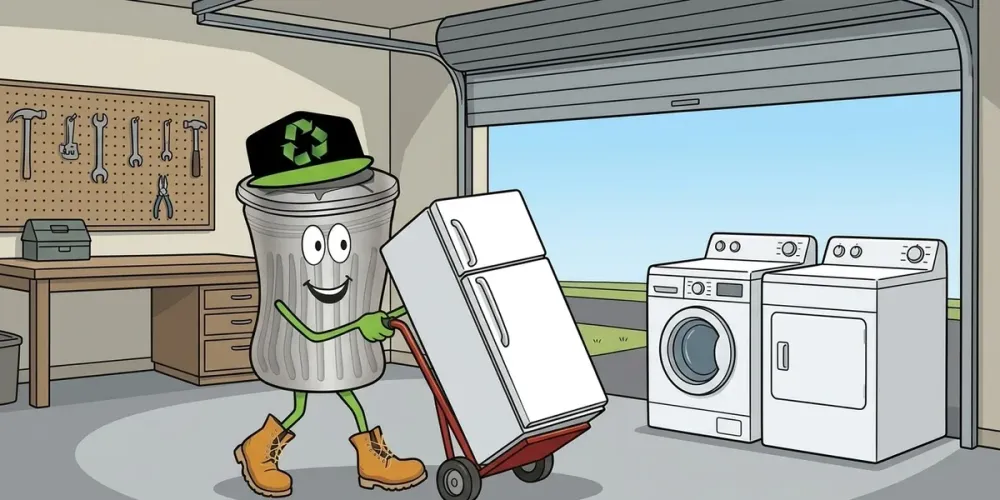
So you have questions about appliance disposal in Framingham, Massachusetts. Good, that is what this post is for. We are going to cover why a fridge is treated differently from a dryer, which appliances can go out at the curb, what appliance removal actually costs, what you have to disconnect before anyone touches it, and where the metal ends up afterwards.
Here is the one thing worth knowing before the rest. Appliances split into two groups everywhere in Massachusetts, and the split is not about size or weight. It is about whether the machine has a sealed refrigeration system inside it. That single fact explains almost every rule you will run into, including why your neighbor’s dryer went and your fridge did not.
Why are refrigerators treated differently from other appliances?
Because of what is sealed inside them. This is federal law rather than something Framingham decided, so you will hit the same rule in Natick, Marlborough or anywhere else we work. Air conditioners, dehumidifiers, freezers and refrigerators all contain refrigerant, and someone certified has to remove it before the metal can go anywhere, to meet the Clean Air Act. Every city and town in the state works to the same requirement, which is why the dryer went and the fridge did not.
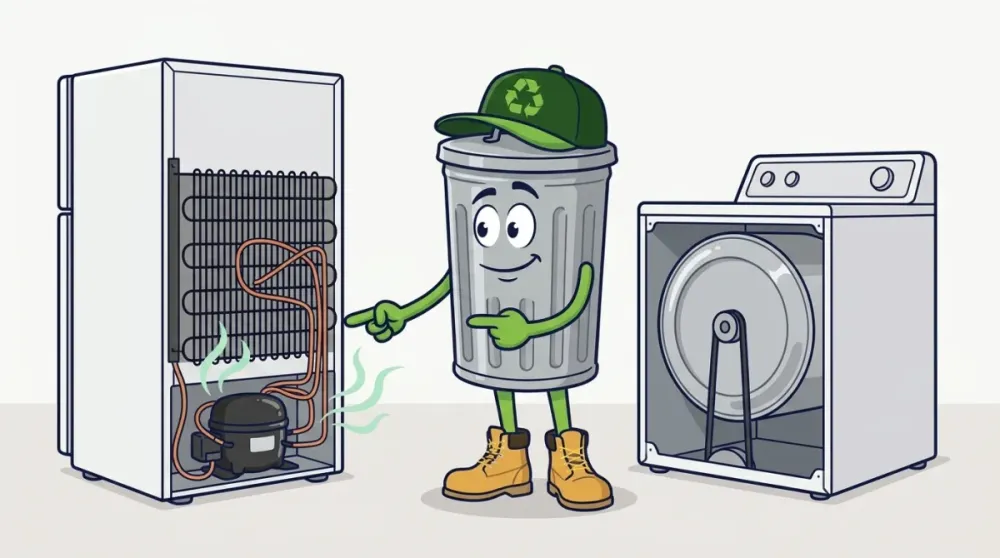
That is why there is usually a fee on those four items
You are paying for the refrigerant recovery, not for the carrying. A washing machine has no sealed system in it. Nobody has to do anything special before it gets crushed, and that is the whole reason a dryer is cheap to get rid of and a fridge is not. Anyone quoting you the same number for both is either absorbing that cost quietly or not doing the recovery at all, and it is worth asking which.
Doors usually have to come off a fridge
Most programs require it and the reason is old and grim. A sealed abandoned refrigerator is a hazard to a child who climbs inside it, because the old latches could not be opened from within. Take the door off before it leaves your house, whoever is collecting it.
Which appliances can go out with normal collection in Framingham?
Fewer than people expect, and never the ones with refrigerant in them. Massachusetts also bans certain materials from disposal statewide, which sits on top of whatever your town does. MassDEP publishes the full waste disposal ban list and it is short enough to read in a minute.
Programs differ town by town even inside MetroWest
Framingham, Natick, Marlborough and Waltham do not run identical bulky waste programs. A rule that a friend in the next town describes confidently is very often not your rule at all. We see this constantly, and it is the single most common reason an appliance is still sitting at the curb two days later.
The city route is slow even when it works
Framingham runs its bulky and appliance collection through Public Works, and the rules move, sometimes part way through a year. What does not move is the shape of it. You wait for a date somebody else picks, the appliance has to be at the curb rather than in the cellar, and anything with refrigerant in it is a separate arrangement again. If the new kitchen is being fitted next week, that is not a plan.
Scrap metal is the item that is usually cheapest
Anything primarily metal has real resale value once it is crushed and sorted, which is why it costs less to get rid of than almost anything else in the house. A washer, a dryer, a stove and a water heater are mostly steel, and steel is the easy half of this job. If you are not sure whether something counts, our what we take page lists it out.
What does appliance removal cost in Framingham?
Less than most people guess for the metal ones, and more than they guess for anything with refrigerant in it. The route out of the house matters more than either.
Single items start at 35 dollars with us
That is the floor price for one item, and a dryer standing in a garage with the door open sits very close to it. Our full pricing works the same way for everything else: we price the work, not the truck space. You get the number first and you approve it before anything is touched, and if you already have a written quote from somebody else we beat it by up to 10%. Forty dollars comes off any job on top of that.
The basement is the variable nobody prices
A water heater or a chest freezer in a finished basement, with a turn in the staircase, is the actual job. The appliance is not heavy in an unusual way for two people. It is rigid, it has no handholds anywhere, and it does not want to go around corners. That is what you are paying for, and it is why we look before we quote.
Do you need to disconnect an appliance before it is removed?
Yes, and this is the one part of the job we will not do for you. It is a safety line rather than a preference, because we are haulers and not licensed tradespeople. A gas stove or a hardwired water heater needs a plumber or an electrician to disconnect it properly, and doing that ourselves would be both illegal and a genuinely bad idea. Book that first, because it is the step that holds everything else up.
Once it is loose, the rest is ours. We carry it out, protect your floors and door frames on the way, and get the metal to a recycler. Stairs, tight hallways and awkward corners are the normal condition of this kind of work. You do not need to move anything toward the door before we arrive.
One thing worth doing yourself: defrost a chest freezer well before the day. A freezer that has been running until an hour before pickup produces a remarkable amount of water on its way up a staircase. Unplug it the night before and leave the lid open with towels down, and your stair carpet will thank you.
What happens to an old appliance after it is collected?
Almost all of it becomes metal again, which is genuinely good news. Appliances are one of the better things in a household to throw away. Very little of one ends up buried, and that is not true of most of what we haul.
The steel goes to a scrapyard
Appliances are among the most completely recycled objects in a home. In 2025 we recycled over a million pounds of scrap metal, and appliances were a serious share of that. You can read more about where the junk goes if you want the whole route.
Working appliances get donated instead of scrapped
If a fridge or a washer still runs, it does not need scrapping at all. Working goods go on to reuse, a lot of it to the Epilepsy Foundation, Goodwill, the Salvation Army and local soup kitchens, and it was thousands of items in 2025. Tell us if the machine works, because people often assume we do not want to know or that saying so will cost them more. Neither is true, and a working machine ends up somewhere better.
What is the fastest way to get rid of an old appliance in Framingham?
Get it disconnected first, then call us. The city route only works in a narrow set of cases, and it is worth knowing which side of that line you are on.
The city’s metal collection only helps if the item is metal, you can wait for the date, and the current rules still cover it. It is the same logic as our advice on bulky item pickup generally.
If it is a fridge, if it is in a basement, if you are clearing a whole kitchen, or if you need it gone this week, call or text us on 603-490-2177. We cover Framingham and the rest of MetroWest most days, we do the stairs, and here is exactly how our appliance removal works.